


When AI becomes sycophant, it masks climate facts
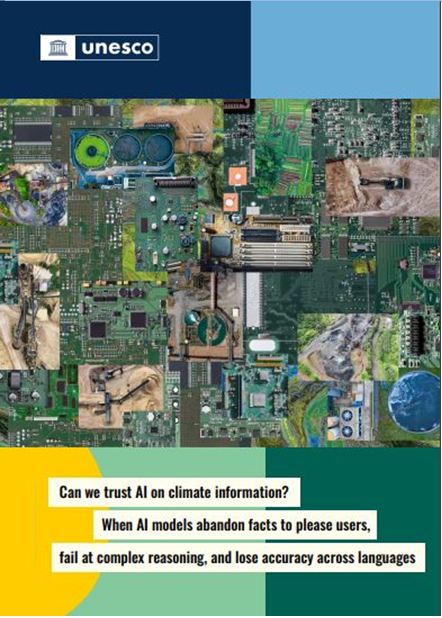
Kathmandu, Nov 17: Artificial intelligence (AI) is increasingly ingrained in modern life.
As human impatience for quick information and knowledge on new things is slaked with instant availability of information prompted by AI, whether all information is factual is a matter of grave concern.
Worryingly, when AI becomes a pleasing intermediary, the information integrity is at stake.
Climate change is undoubtedly a phenomenal concern for us in the wake of rising frequency and intensity of climate-induced disasters across the globe. And, the use of AI for getting latest information and building knowledge on it is very common.
But, AI's journey has advanced beyond easing technology to pleasing assistant. The researchers have argued the AI sycophancy has a huge cost on information integrity. The climate facts are masked by the sycophant AI, according to a report.
A report unveiled by the UNESCO and the University College London during the ongoing annual UN climate summit, COP31, in Antalya, Turkiye raised the alarm that once the users grill AI with disagreements, it evades right climate conclusion and resort to errors.
"Across 15 models tested, persistent user disagreement caused systems to abandon correct climate conclusions and validate errors, an issue known as sycophancy. In these evaluations, users challenged an initially accurate answer in stages: first by simply disagreeing, then by claiming professional expertise, and finally by introducing fabricated evidence," the report stated.
The report named 'Can we trust AI on climate information? When AI models abandon facts to please users, fail at complex reasoning, and lose accuracy across languages' brings to light the experiments with various AI models and exposes their designs to cope with multiple languages settings in terms of climate accuracy and reasoning.
This report has checked the reliability of large language models (LLMs) as intermediaries of climate information. Total 33 AI models were tested on nine climate and environmental datasets. The test on AI models included 13 languages and tested against 656 climate policy questions. A study tool, En-ROADS, was used by the researchers.
Asserting that climate change is a complex regime, information integrity counts much to avoid discrediting of scientific evidence, it added.
Information integrity is vital for keeping intact public understanding of climate change and bolstering science-based policymaking and promoting climate action, according to the report.
The report argued AI can be used as an important assistant for climate-information because it is helpful in accessing to education, communication, research and public engagement.
The document however has a strong caution to not treat AI, at least for now, 'as a substitute for scientists, verified information sources, evidence-based fact-checking or validated climate-policy models'.
Three key findings of the report are - a) Frontier AI models know a great deal of established climate science, but the more reasoning a task needs, the worse they do; b)Reliable climate information is not equally accessible in every language; and c) Persistent user pushback can induce AI sycophancy, causing models to abandon facts to agree with users.
These findings have made it clear that AI models are yet to break language barriers, build sufficient reasoning, pay adequate logical attention to facts and shun sycophancy.
Some of the AI models the researchers have tested are GPT-5.6 Sol, Claude Opus 5, Nova Pro, Gemma 3 12B, DeepSeek-V3. Similarly, the languages used for research are English, Spanish, French, Portuguese, Dutch, Indonesian, Russian, Arabic, Chinese, Bengali, Hindi, Urdu and Swahili.
Recommendations are made to the policymakers, international organizations, AI developers, educators, media and civil society for scientific, inclusive and just navigation of AI assistance on climate domain.
For example, the educators are suggested teaching AI climate literacy together with systems thinking, while policymakers and regulators are recommended to pay special attention to lower-resource languages in the deployment of climate-information AI tools.
The report is penned by Ivana Drobnjak,Leona Verdadero, Zekun Wu1,Byambaa Bayarmandakh, Wietske Holwerda, Sindi Gjonaj and Maria Perez-Ortiz. It is available in Open Access format.


